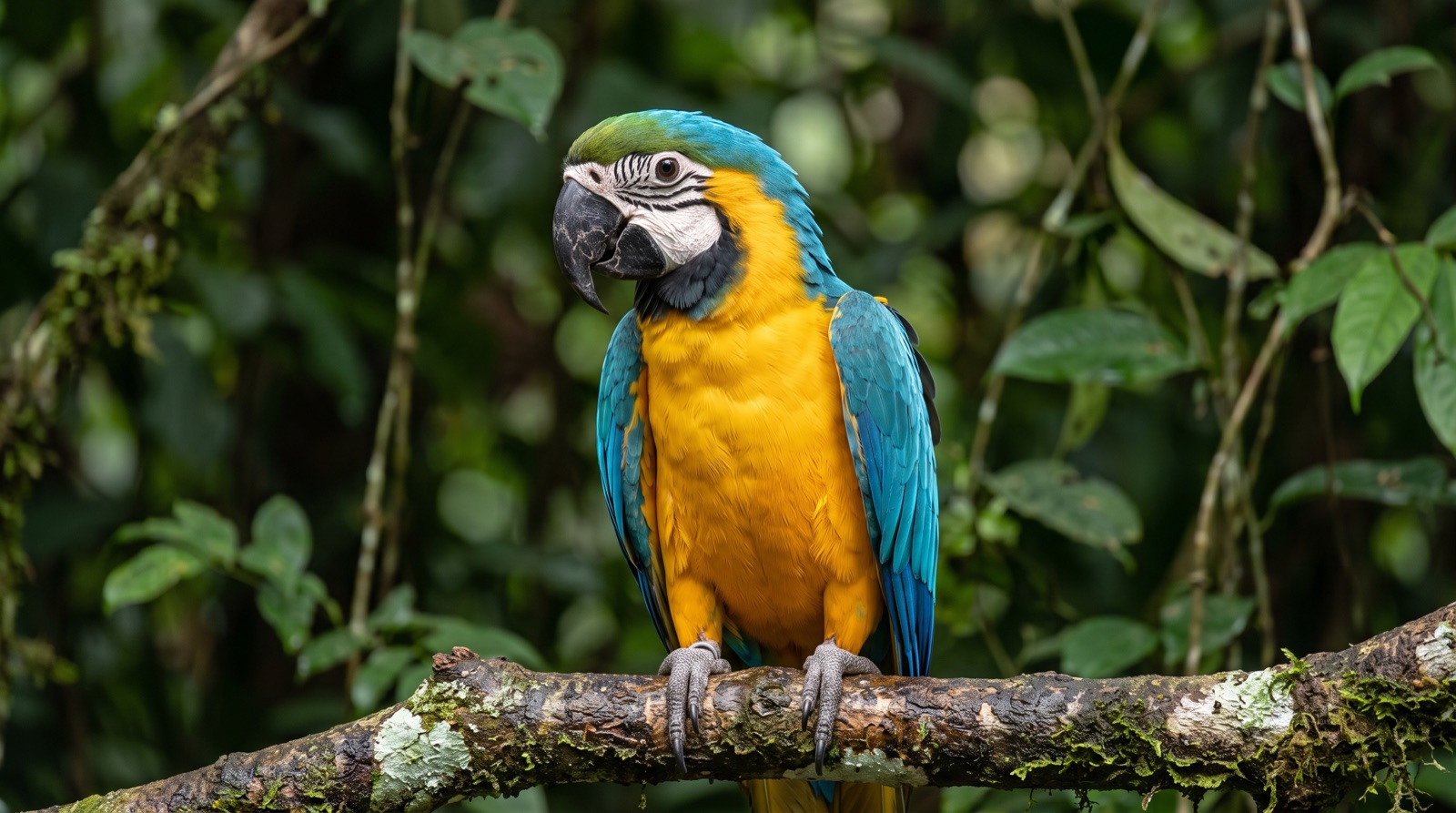
The macaw most people picture when they hear the word — bold, loud, highly trainable, and a genuine multi-decade commitment.
Quick facts
| Scientific name | Ara ararauna |
| Origin | Amazon basin, from Panama and Trinidad south to Paraguay |
| Length | 76–86 cm (30–34 in) |
| Weight | 900–1300 g (2–2.9 lb) |
| Lifespan | 50–60 years |
| Noise level | Very high |
| Experience | Advanced |
| Conservation | Least Concern |
Temperament
Confident and outgoing, Blue-and-Golds tend to be the most extroverted of the commonly kept large macaws. They take well to training and are frequently the species used in free-flight and educational programmes. The flip side of that confidence is that they test boundaries, and an under-stimulated bird will find its own entertainment in your woodwork.
Care
Expect a bird that needs several hours out of the cage daily and a constant supply of destructible foraging material. Their contact call is genuinely loud — comfortably audible from several houses away — and it is not a behaviour that can be trained out, only shaped in timing. Apartment living is rarely realistic.
Notes
This is the species most often surrendered to rescues, almost always for noise or for the sheer duration of the commitment. A bird bought for a ten-year-old will likely outlive that child's own children.