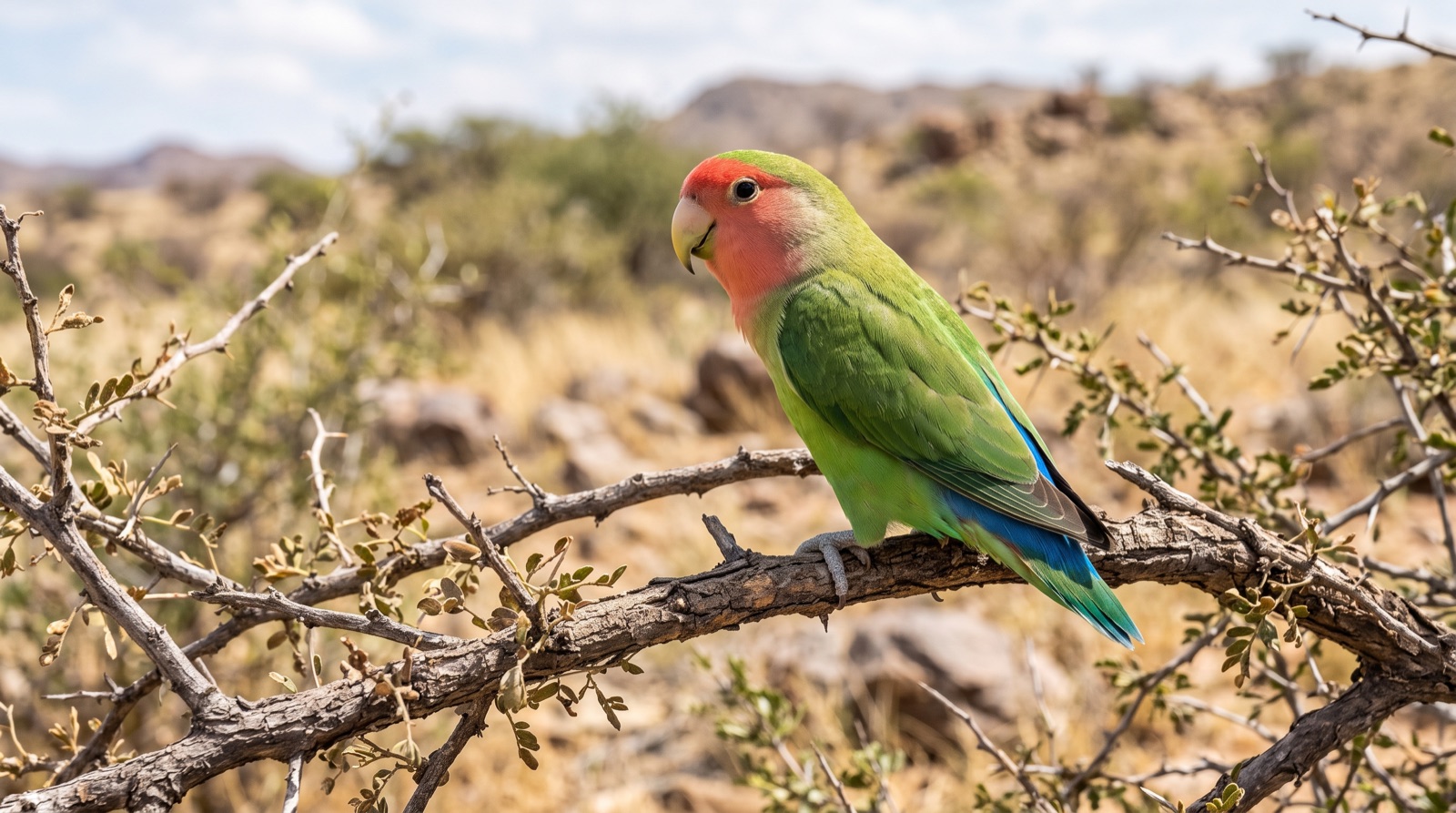
Small, vivid and far more assertive than their size or their romantic name suggests.
Quick facts
| Scientific name | Agapornis roseicollis |
| Origin | Arid south-western Africa, chiefly Namibia and south-western Angola |
| Length | 15 cm (6 in) |
| Weight | 45–60 g (1.6–2.1 oz) |
| Lifespan | 15–20 years |
| Noise level | Moderate |
| Experience | Beginner to intermediate |
| Conservation | Least Concern |
Temperament
Lovebirds are bold, busy and often surprisingly territorial, quite willing to challenge much larger birds. The common belief that they must be kept in pairs is not accurate — a single lovebird given proper attention makes a closely bonded companion, while a bonded pair will largely ignore people. They are not meaningful talkers.
Care
Active and needing more flight space than their size suggests. Standard small-parrot husbandry applies, with the usual warning against all-seed diets. Females are enthusiastic nest builders and will shred any available paper, tucking the strips into their rump feathers to carry them — a behaviour unique to this genus.
Notes
Chronic egg-laying is a common problem in single females and a genuine health risk through calcium depletion. Managing light cycles and removing nest-like sites are the usual first interventions.