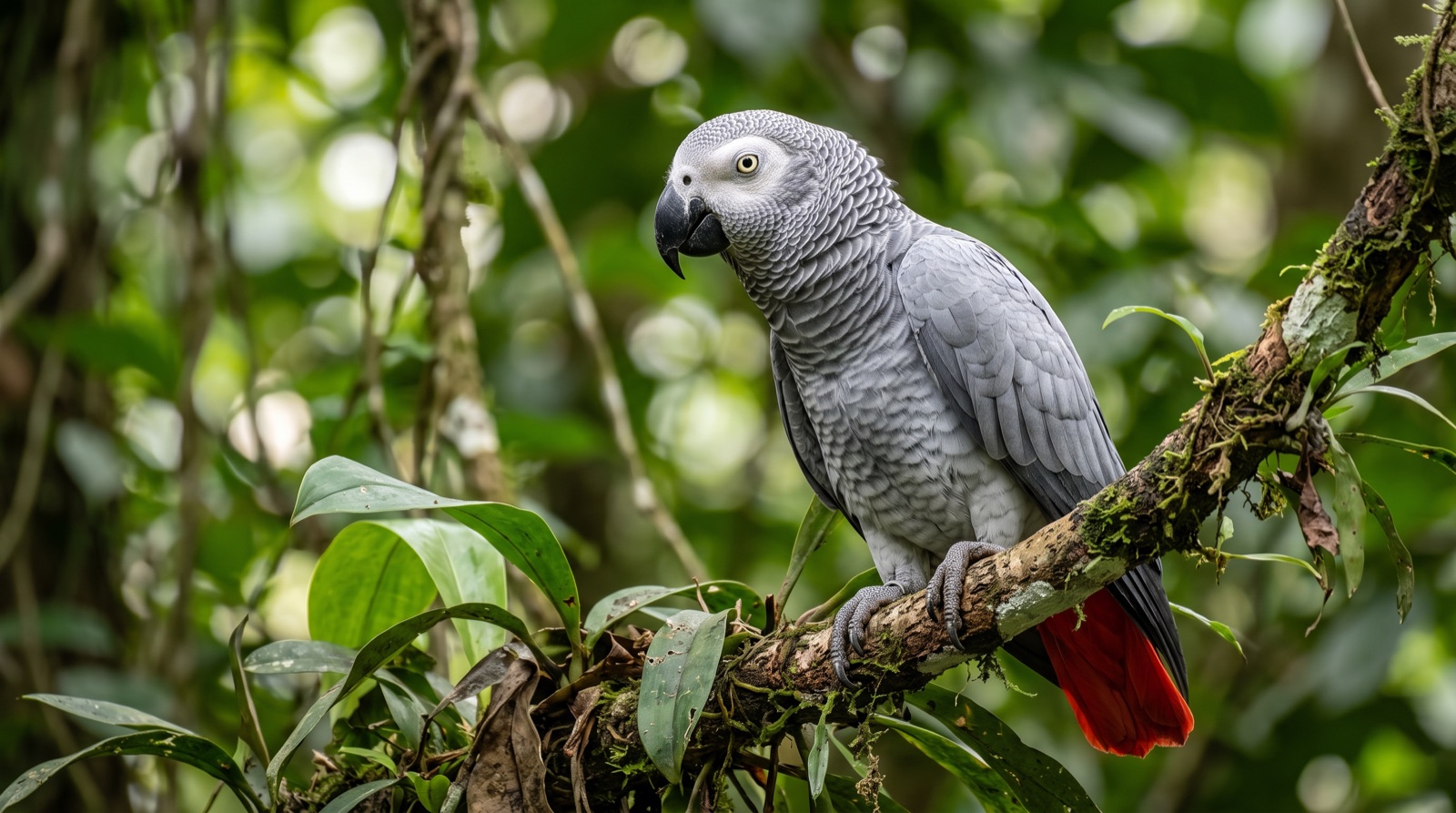
The species that made parrot cognition a research field — brilliant, sensitive, and demanding in ways that have little to do with noise.
Quick facts
| Scientific name | Psittacus erithacus |
| Origin | Rainforests of West and Central Africa |
| Length | 33 cm (13 in) |
| Weight | 400–550 g (14–19 oz) |
| Lifespan | 40–60 years |
| Noise level | Moderate |
| Experience | Advanced |
| Conservation | Endangered |
Temperament
Greys are observant, cautious and slow to trust, and they generalise fear readily. A frightening experience in one room can produce lasting wariness of that room. They are also exceptional vocal mimics, frequently reproducing not just words but the specific voice and intonation of a household member. Contextual use of vocabulary is well documented.
Care
This is a species where the mental side of husbandry outweighs the physical. Foraging opportunities, novel problems and predictable routine all reduce the risk of feather-destructive behaviour, which is common in under-stimulated Greys. Greys are also prone to hypocalcaemia, so dietary calcium and either natural sunlight or appropriate UVB access are standard recommendations rather than optional extras.
Notes
Uplisted to CITES Appendix I in 2017 after catastrophic trapping pressure, and now listed as Endangered. Legal ownership requires proper documentation in most jurisdictions. Irene Pepperberg's thirty-year work with a Grey named Alex is the reference point for the species' cognitive reputation.