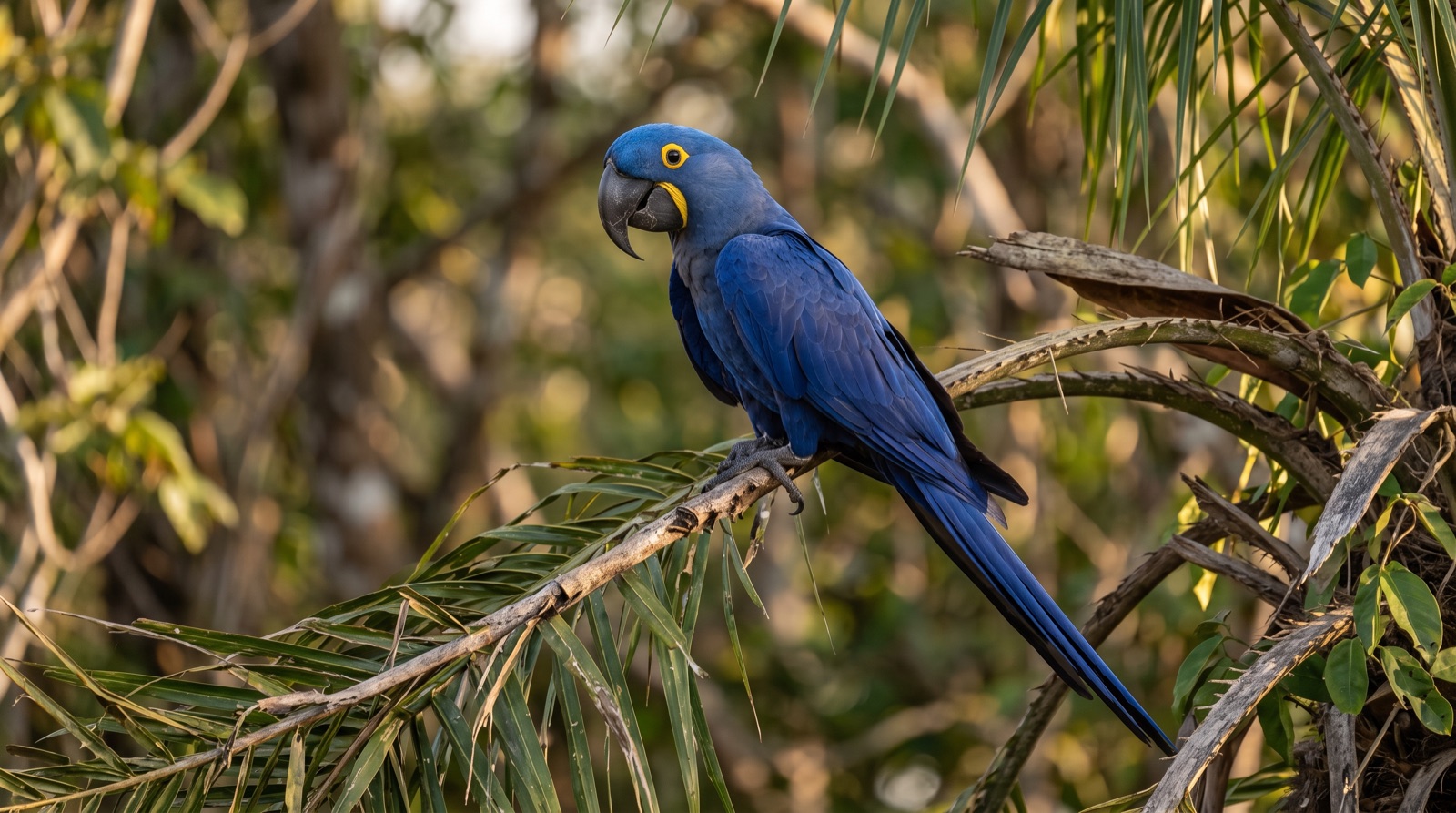
The largest flying parrot in the world — cobalt blue, startlingly gentle for its size, and entirely unsuited to a first-time owner.
Quick facts
| Scientific name | Anodorhynchus hyacinthinus |
| Origin | Cerrado and Pantanal of central Brazil, eastern Bolivia, north-eastern Paraguay |
| Length | 95–100 cm (37–39 in) |
| Weight | 1.2–1.7 kg (2.6–3.7 lb) |
| Lifespan | 50+ years |
| Noise level | High |
| Experience | Expert |
| Conservation | Vulnerable |
Temperament
Hyacinths have a reputation for being remarkably even-tempered, and among experienced keepers they are often described as gentle giants. That reputation is real but easy to misread. A bird this size has a bite force capable of cracking hard palm nuts, and a startled or hormonal Hyacinth is not something a novice can safely manage. They are intensely social and form strong pair bonds, which in a household setting translates into a bird that wants contact for most of its waking hours.
Care
Housing is the first obstacle: a Hyacinth needs an enclosure measured in metres, not centimetres, and stainless steel is effectively mandatory because they destroy lesser materials. Their diet is unusual among parrots in being genuinely high in fat, built around palm nuts such as acuri and bocaiuva. Macadamias and other hard-shelled nuts stand in for these in captivity. A low-fat pellet diet designed for other large parrots is not appropriate for this species.
Notes
Wild populations were devastated by the pet trade in the 1980s, and the species remains Vulnerable with an estimated wild population in the low thousands. Legitimate captive birds are documented and expensive. Anyone offering one cheaply or without paperwork should be treated as a serious warning sign.